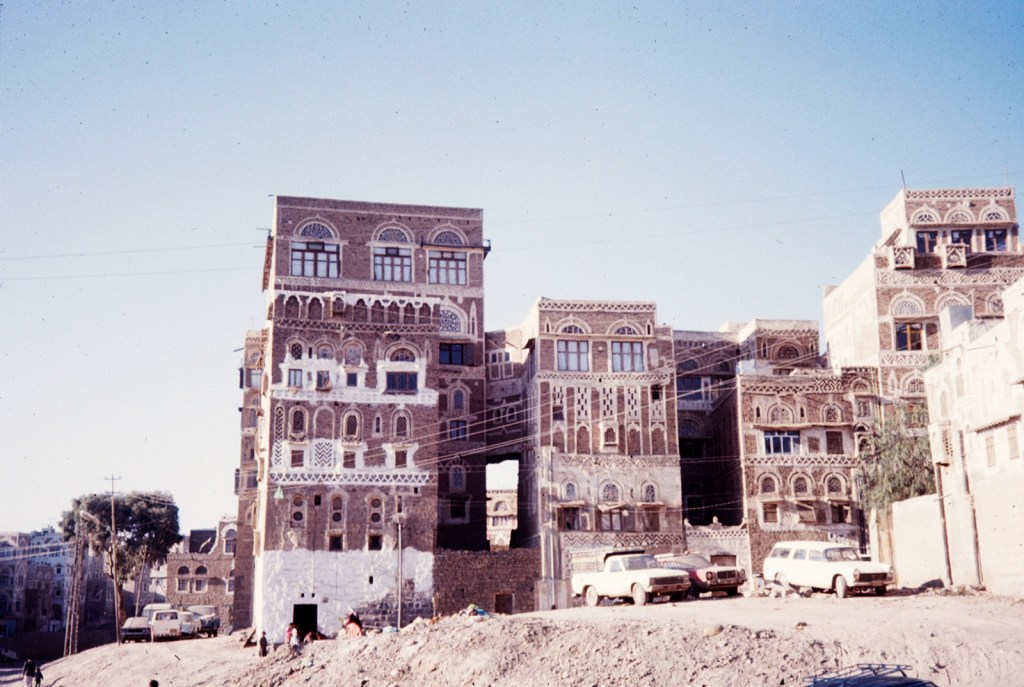
Mum made an extensive visit to Yemen in January/February 1982. She flew Aeroflot via Moscow overnighting at an InTourist hotel, ‘where no-one speaks much English’ and because ‘most travellers on Aeroflot were a pretty low grade lot those who looked after us were not of very high quality either’.
Sana’a
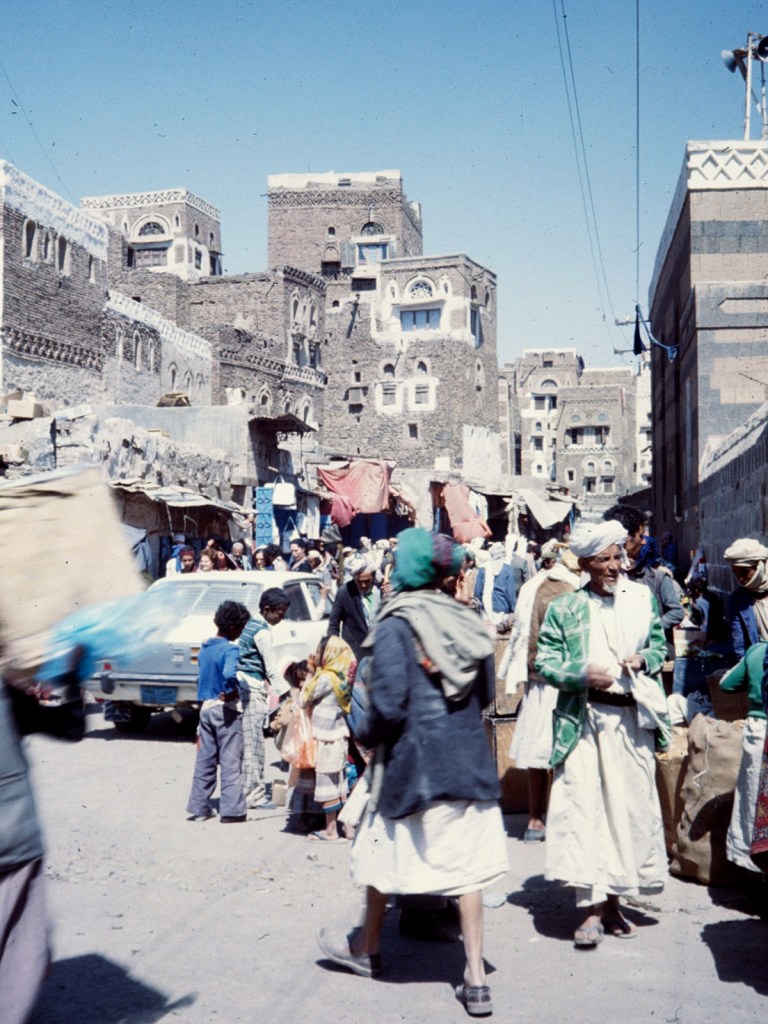
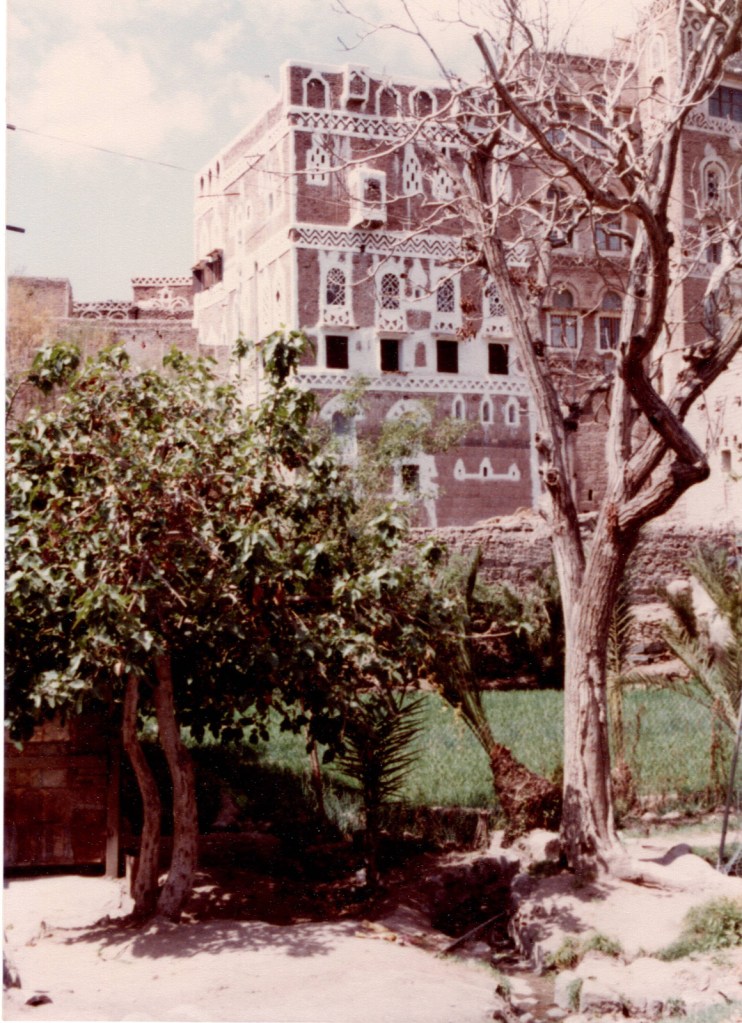
She was the guest of Leigh Douglas, a friend of Neville Chittick’s (who had written ‘a rather vague’ letter of introduction), Director of the Yemeni institute of Yemeni Studies, who met her at the airport. ‘ He is quiet, kind and helpful…The streets could have been any Middle Eastern town, save for the traditional houses made of brick, tall and tapering, with windows outlined in white, flat roofed with crenellations and finials [as above].’ It was then a city of only 120.000 inhabitants.
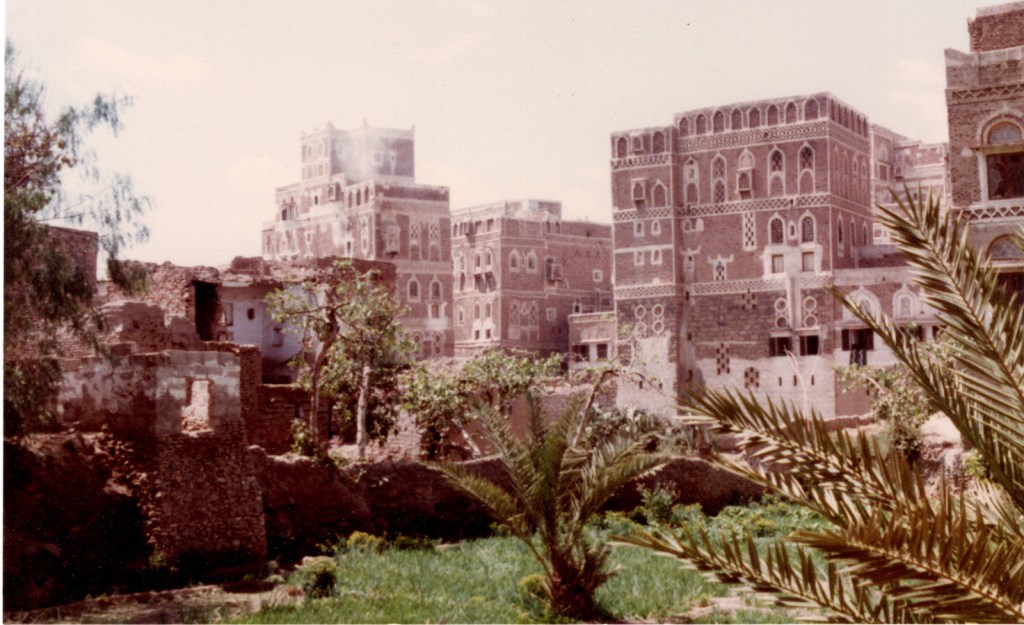
At the institute she had a room comprising two beds, an armchair, a chest of drawers. Her fellow guests were a mix of anthropologists and researchers, USAID workers, and the institute served as a hostel with a communal kitchen, shared bathrooms etc. She soon made friends with various in-mates and their friends and began making social visits – looking for chests of course, although when she registered her intent at the Cutural Centre she was was told they ‘didn’t exist here’ but on proffering a photo she was told they were Indian, ‘which was something.’
The shops and the suqs are of the usual one or two floor variety, perhaps 8 or 10 feet wide, which can be closed completely by two overlapping doors with a central door post. Every now and again you come to a large several- floor building which was a caravanserai in the old days.
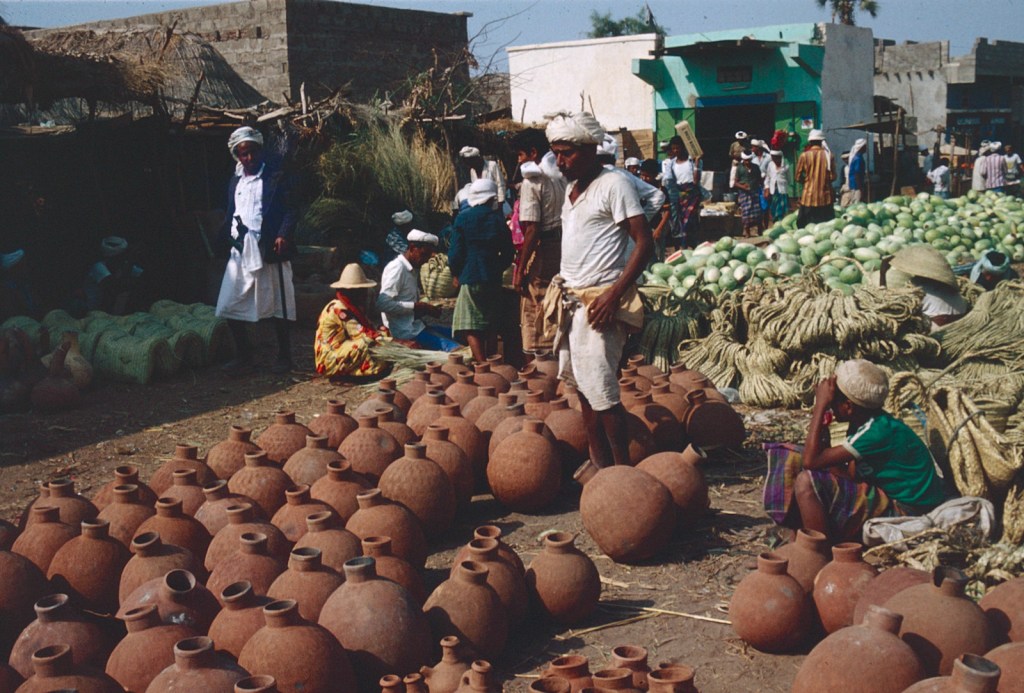
Everyone very pleasant – children go about playing in the dust, quarrelling with pulling of hair and kicks on one occasion. Women usually wear a big gathered skirt, a muslin cloth in black, red and white covering their whole faces… bundles of qat were exchanging hands.
Still in pursuit of chests, she visited the British Council who introduced her to the director of antiquities and invited her to dinner as he had two chests at home. She also tracked down an Iraqi archaeologist who had known Neville and ‘is a most interesting and interested person and she gave me all sorts of suggestions as to places I should visit’.
She used Sana’a as a base for her various sorties in to the interior. Most of the time she spent ‘chasing people who weren’t there’ and reading newspapers at the British Council. She suffered from altitude sickness, ‘constant headache and lightheaded fleeing’.
It was here she met Francine, an ethnographer with a group studying the Tihama region, who was to become a great friend. They were also staying at the Institute Guest House.
Qat party
Social life seemed to revolve around large qat sessions ‘the is the leaf which people chew here, a kind of stimulant which takes up everybody’s time’ and makes them ‘quite high’.
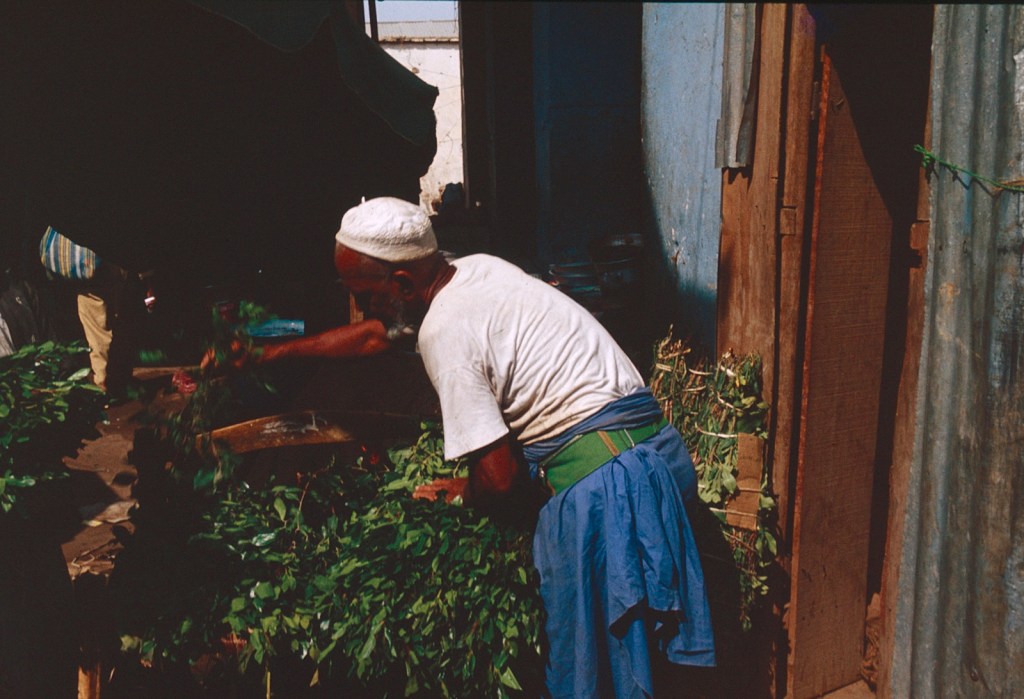
The qat is normally quite a large branch of the shrub; you smooth the leaves you intend to pull to cleanse them of dust. Usually only the young and tender ones are used and you push them into one side of your cheek to begin with. It’s best to strip a whole pile and put them in at once to form an initial wad; you chew them gently, taking care not to swallow any. They are drying to the mouth and have a curious green taste; then saliva begins to flow and you have to be careful only to swallow that and not the leaves.
We chewed on. Two hubble-bubbles, for want of a better name, had their mouth pieces passed around. I didn’t like it much but was persuaded to try again and succeeded in producing deep bubbles before puffing out the smoke. Then appeared an immaculate young Yemeni in a spotless khanga and an Afro head of hair, aquiline nose, fairly dark-skinned with a glinting gold tooth. He is a famous oud player and singer, composes songs, makes tapes and appears on the TV.
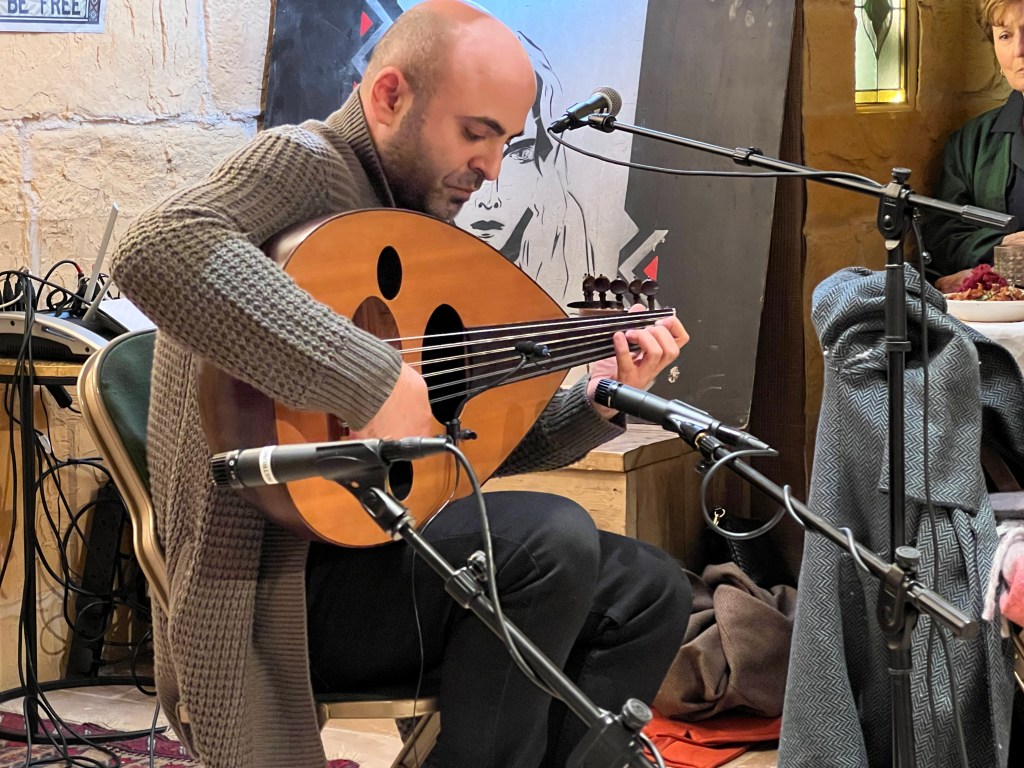
A beautiful new oud was produced. I think it came from Egypt. He played and sang all manner of songs and was was much applauded. Sitting in the corner by him was another Yemeni, a qat cellar from the suq. There appeared another player, not quite so professional but with a softer voice; he arrived with a rounded cheek of qat so he must’ve come from another ”chew’ party. They are popular on Thursdays.
Music and chewing went on for several hours. At about 8 pm or so we disposed of our wad of qat into a spitoon and washed out our mouths. One becomes very relaxed and clear-thinking and inhibitions vanish…tea and thermos was brought in and we drank from glasses.
More singing and reefers were rolled and passed around. I refused at first but did have a puff eventually. I didn’t think it was enough to affect me as I didn’t inhale. By about midnight, people drifted off – those that remained singing French songs, Bob Dylan songs and so on – I didn’t know many but they were attractive. Soon we packed up and drove around the city to drop people home and avoid the police because after 10 pm they look for terrorists. Foreigners aren’t affected, so we were not held up. Home at 1 am exactly now 1.50. I’ve written this to try and get tired as qat is stimulating, you don’t feel hungry and you don’t sleep. Luckily the peppermints which were handed round to save me from what appeared to be indigestion and a tightening of the stomach caused no doubt by odd juices and tiny pieces of qat having escaped downwards.
The next day she got up late feeling ‘unexpectedly fresh and unsleepy’ but after breakfast and feeling ‘somewhat odd not really hung over but not 100%’, she eventually set out to explore city and the suq, map in hand. ‘Some of the houses are extremely tall. They are mostly built contiguous with one another and have ancient doors with carvings on them and many windows some with some alabaster and some screened by moulded plaster screens with or without coloured glass inserted in them. She later reports that ‘my mouth is really very sore from the qat but I’m told by the Wilsons who called today that it will go but what do you do until it does?’
An unpleasant encounter
Sheila was getting rather bored in Yemen as she had had few leads so she resorted to exploring round Sana’a. She had come across an old samarah or caravanserai. the ground floor was used as storage, and the man who had let her in spoke a few words of English and seemed ‘harmless and obliging, indicated I should climb the stairs to the upper floors’…as she was about to ascend the final stair case for the view, he ‘gestured for me to wait and fumbled with his futah [traditional garment] and brought out the most enormous penis for one of his size that I’d ever seen…horrified and somewhat alarmed, I firstly shouted “mushquais” [not good] and fled to the stairs, he endeavouring to clutch me and, as I disappeared down the stairs as fast as I could go, saying “very sorry”, and as I drew ahead and his steps were way behind, “very, very sorry”..well it was a shock and a disappointment having been led to believe in the kindness and good behaviour of the Yemenis.’
She had another unpleasant encounter a couple of weeks later in Sana’a, where she was ‘accosted by a young man who after the preliminary welcomes to the Yemen and come to my house for tea, then said I want to do sex with you – and wasn’t easy to shake off…’
Wadi Dahr
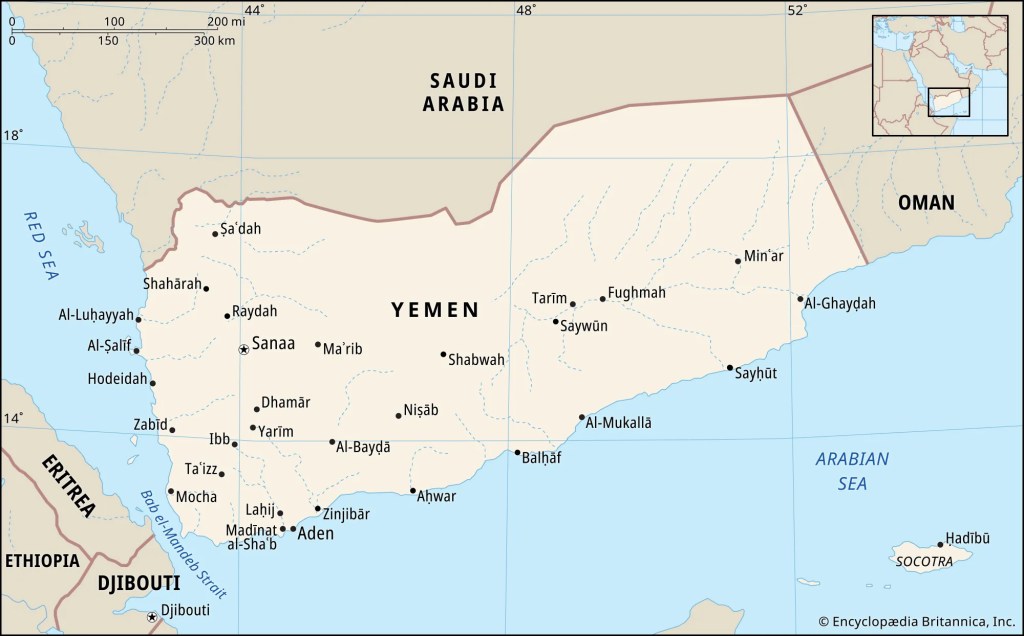
Feeling frustrated and the need to overcome her apparent inertia, she decided to tackle a trip to the nearby Wadi Dahr. This involved getting a collective taxi from the main square but, without much Arabic and no one speaking, English this was quite challenging. Taxi identified and seated in the front seat, it was started by someone opening the bonnet and knocking an element with a stone, which started the engine. Her fellow passengers were very jolly and fed her with fruit.
The road now became unmade up and bumpy. We turned this way in that through the gorge under a huge monolithic group of tall rocks said to be an ancient castle and down into the village – a few shops, dirty and untidy, and a number of people hanging about, also lots of dogs nosing and nudging for food. We drove on and I was dropped off at the foot of an incredible building. A castle, I should say, parked on top of a large lump of rock and at least 100 feet, high shady trees nearby, but people didn’t take much notice of me luckily. I decided to look around before seeing if I could go in.

This proved impossible as there was no key. She heard later it is an army guesthouse. Nevertheless, she enjoyed hanging out with the women and children in the countryside watching people watering their goats and their gardens, and taking photographs. No one really took much notice of her, not even the children who, after asking her for pens, carried on with their games. She managed to get a taxi back to Sana’a, sole occupant, as the driver was anxious to make it back to town to sell his qat which he kept on liberally dousing with water to keep it fresh.
Shibam
First Sheila had to get a taxi to Marib (on the map) ‘nine passengers, 2 infants, 4 in middle and 3 squatting in the back, I was in the middle, most frightfully uncomfortable, my right leg ached from hip to ankle, my rib cage sore given the young man next to me kept shifting, eventually settling himself with an un-protective arm round my shoulders’. Poor Mum!
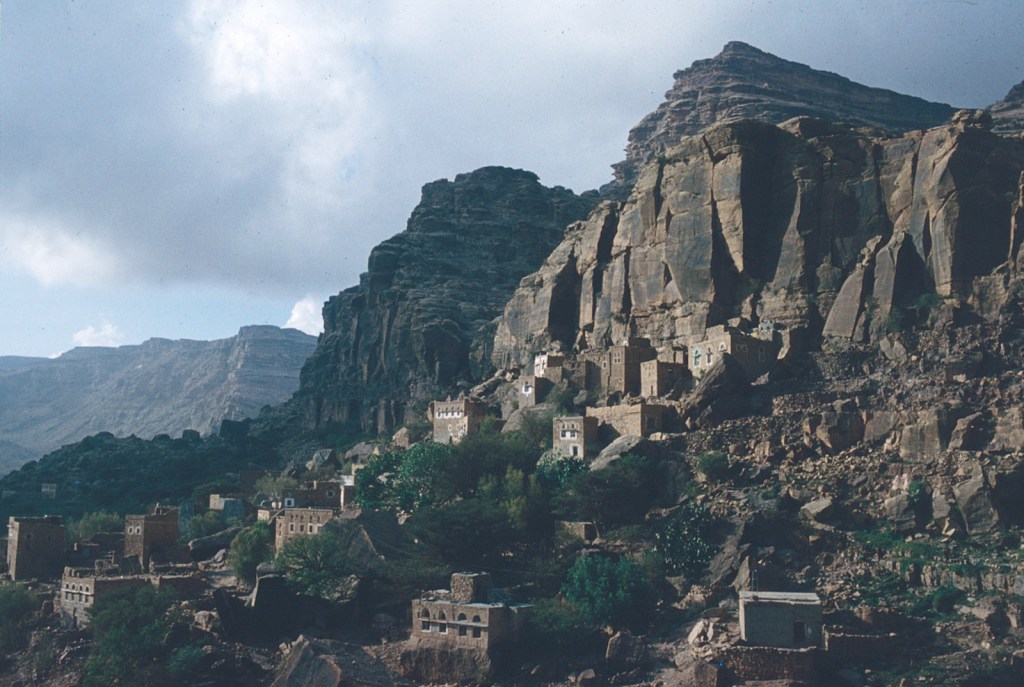
Her destination was the ancient town of Kankoban which could only be reached by a very steep climb up a rocky escarpment. When she eventually arrived at the top, she saw ‘the town gates with a set of doors and a kind of guardroom…the little town consisted of numerous houses, set out on the uneven mountain top….near the bottom of the cliff were were several inhabited caves cut out of the cliffs, some with doors and windows’. She was unable to find the ‘hotel’ so returned to Sana’a at break-neck sped in a shared taxi, the driver ‘no doubt aided his qat euphoria’.
Taiz
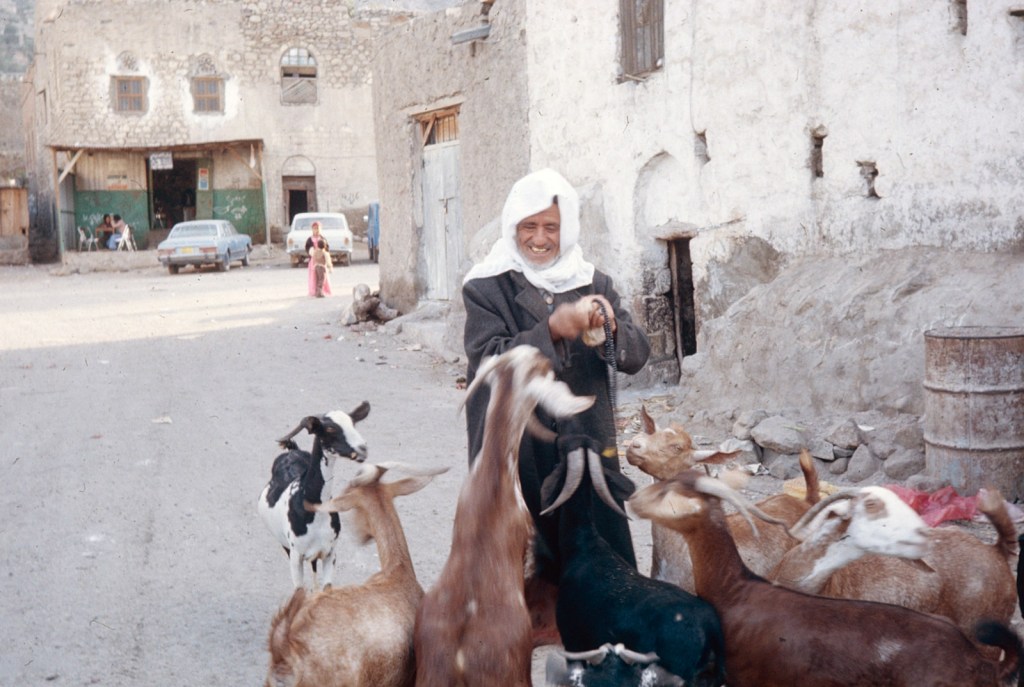
Another shared taxi. ‘First through Highland plains ringed with mountains then though a pass in the hills and down further….by the side of the road were the sad carcases of donkeys, cows, a sheep, cats and dogs in various stages of decomposition…you’d think people would look after their animals but they all roam about in twos and threes, untended..
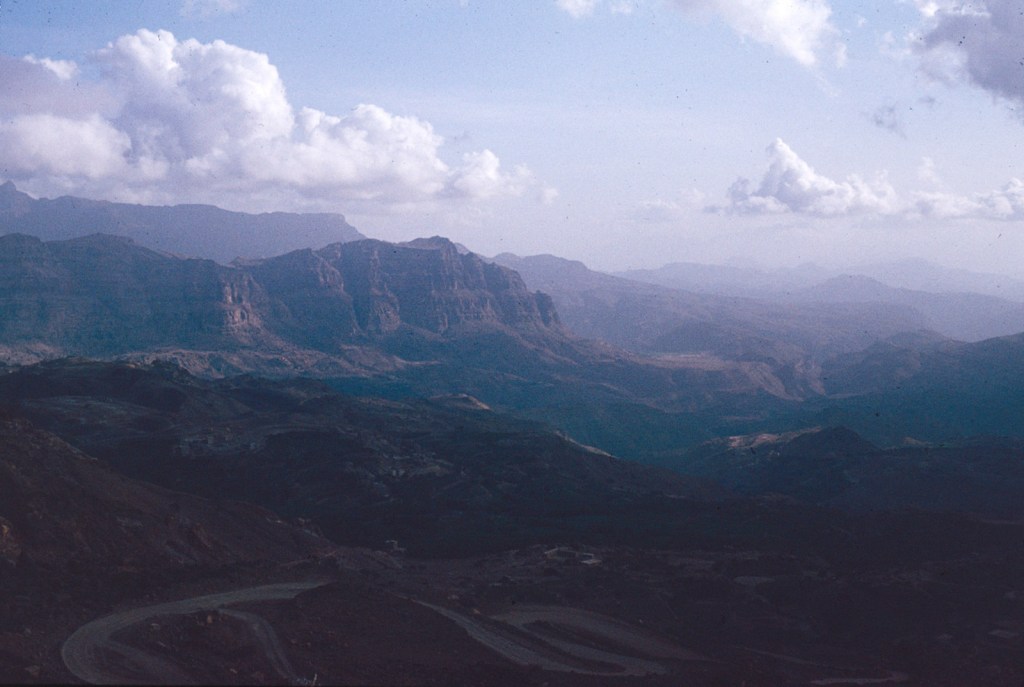
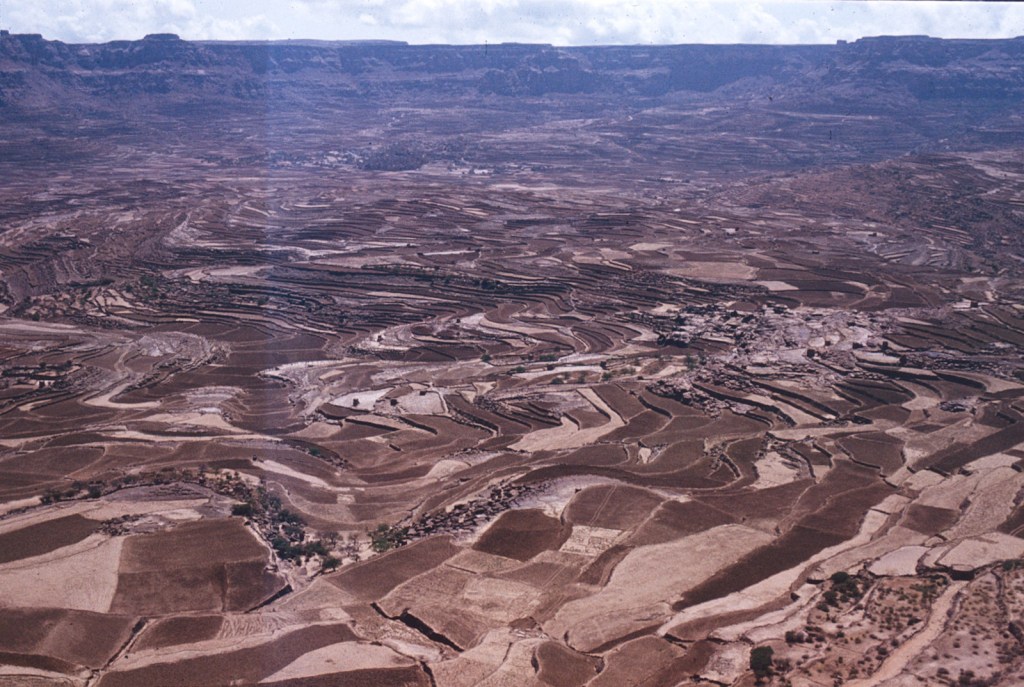
After 80 miles or so the scenery became quite spectacular, the road, which was constructed by the Germans, twisting and turning round the mountain sides, on the top of which perched fairytale castles, and down far below you could see the slopes and terraces right down to the valleys where the fields were bright green.
After a lunchstop in a very dirty village with rubbish everywhere, a small boy peeing off the side of the road, her neighbours became more chatty and offered her qat, ‘a good thing to keep the driver awake as the road was so twisting and breathtaking.’
Approaching Taiz it became greener still, with eucalyptus trees lining the road and some places there’d been an attempt to plant more exotic roadside trees – flamboyants and such like. Taiz itself is on the western slopes of a mountain range – as the second biggest town it is as unattractive on entering as you might expect…
After one night in an overpriced hotel and found the museum shut (the purpose of her visit) and wandering around the suq – ‘nothing special’ – she was ‘glad I had decanted some whisky to cheer me up’.
The following day the museum was open.
There must’ve been at least three stories, each room crammed with memorabilia of the last Imam Ahmed who died some 10 years ago of a natural death; he was said to have had bad arthritis which he dosed with morphine to ease the pain and he became an addict. The overall impression of trash and dust and sad and depressing.
Finally the door was unlocked and I was taken down a passage where at the end was the room where the Imam had died. The morphine bottles were pointed out though I didn’t see them. I did notice bottles labelled Gordon‘s gin. The guide surpassed himself and showed me everything with demonstrations, including a fountain pen that turned into a gun, so suitably tipped which pleased him. I came away depressed. It was so tawdry even the inscribed salver from King George VI deemed in poor taste despite a hallmark.
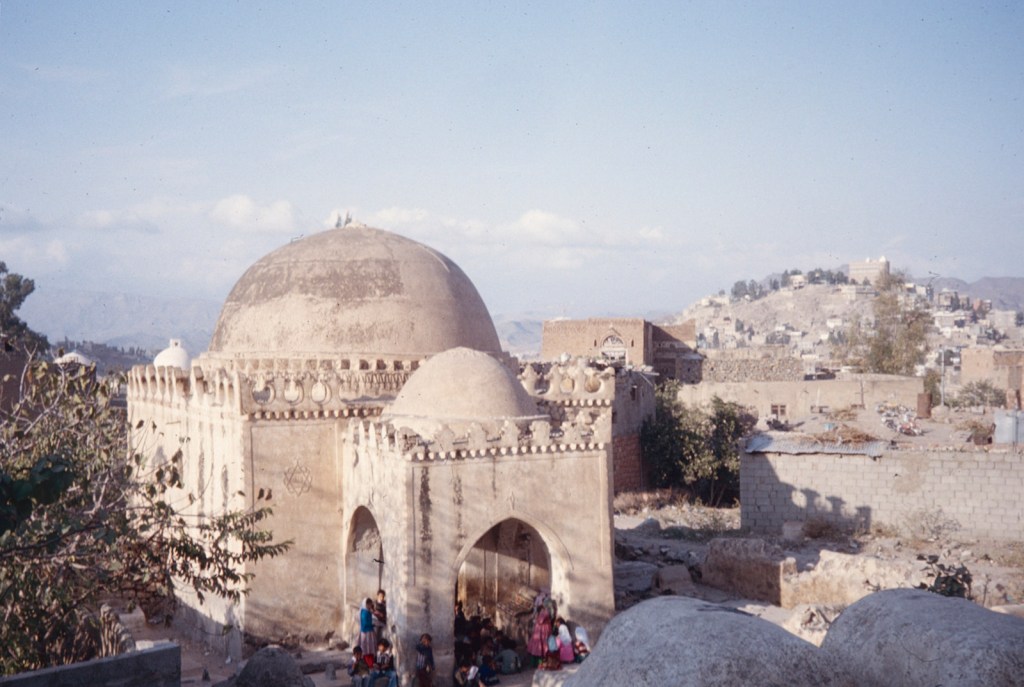
Feeling resigned and depressed on her way back to the hotel she spied a notice saying British Agricultural Project and on impulse she entered the gate ‘to see if I could see anyone looking remotely English and there stood a man who at once greeted me outstretch hands. “John Sim”, he said. He sprung into action, introducing her to an American couple who were expecting a baby imminently, but they invited her to stay, warming to her cause. They took her to see some Yemeni women friends, where they sat around chatting and she was dressed up in Arab dress – ‘ a heavily pleated satin-like skirt, veil and headrest…they admired the colour of my eyes which they compared with my blue ring’.
She spent several days with Cathy and Bruce, who took her around and about and introduced her to some extraordinary people including a half Liverpudlian/half Yemeni midwife who had lived in Taiz for 35 years, delivering babies and looking after women’s health.
Zabid
John Sims dropped her off in Zabid. They had moved into the Tikameh desert region ‘dry sandy coastal plains, with thorn bushes, the odd tamarind tree, camels – all very brown before the rains.’ He found her a funduq (hostelry) and departed for Hodeidah
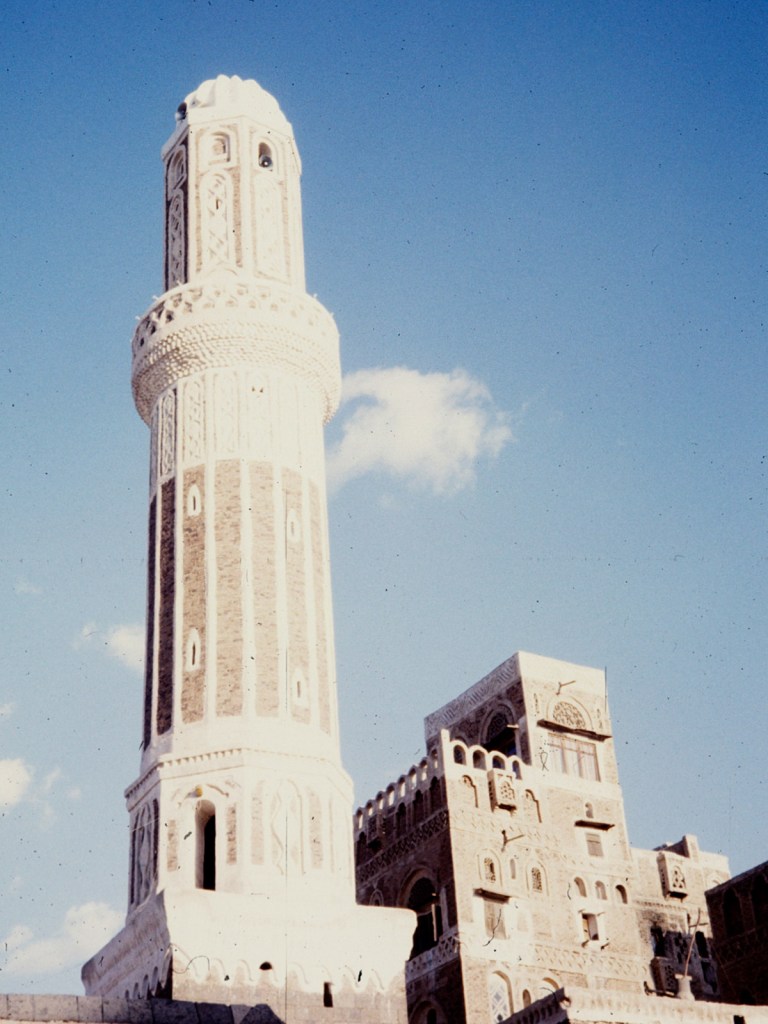
Zabid is a small town on quite a tell, evidence of its long occupation on that spot. The famous old mosque with its tall minaret is on the walls on the left as you enter…doors are often decorated with fine carved centre pieces, lanes are narrow and twisting and there are many mosques.
On her own in Zabid, Sheila managed to find some nice Canadian archaeologists who befriended her and took her out to dinner. Really she was intrepid and resourceful. Travelling In Yemen on your own in the early 80s cannot have been much fun!
Hodeidah – a very dreary modern town
Incredibly dirty city with drains coming up green and smelly all over the place, brown grey sand, quite English-looking, with waves breaking.
Numerous check points near bigger towns where soldiers poke their heads in to look for terrorsits and boots are searched for arms. As an visitor you have to have permission from the Tourism to allow you to go to various places and your passport is examined, usually from the wrong end.
The coast – trip with Leigh
They travelled along the coast road via Hodeida until they reached their destination – an old Turkish fort ‘on a sandy bluff on the seashore’. They made camp there but Sheila and Leigh slept in the fort itself, she in an open passage-way above the entrance gate, on a camp bed ‘under the stars – very bright this dark moonless night’.
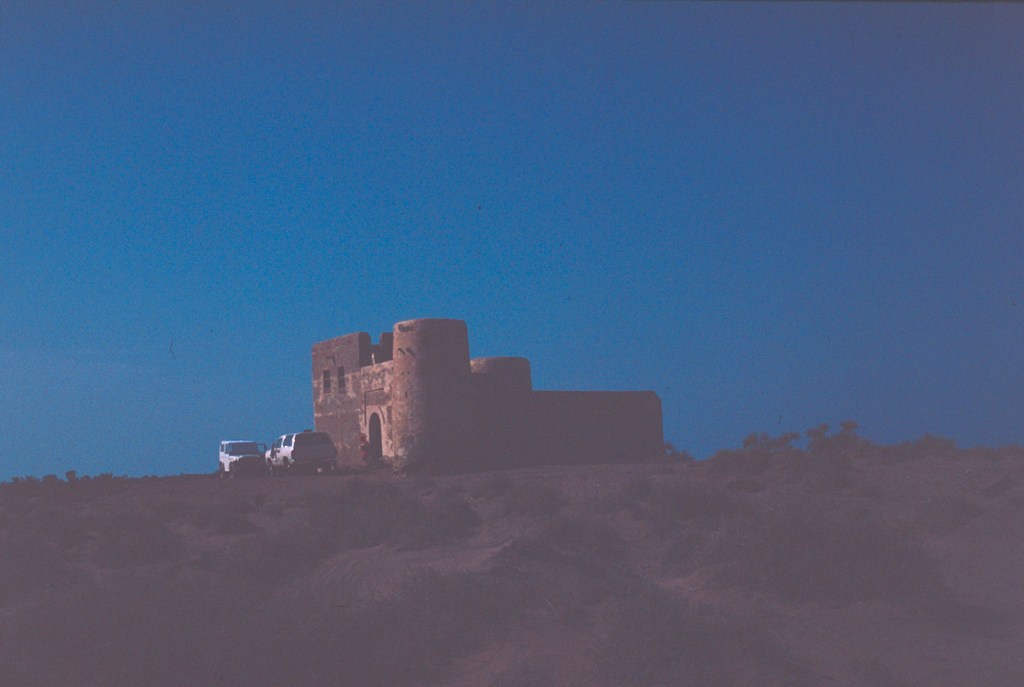
The following night they camped on the beach beside ‘the sad remains of turtle shells’, barbecued fish ‘ and altogether got rather sunburned’. The only other event of note was getting stuck in the sand in their posh US Embassy 4WD which no-one knew how to operate – luckily some locals came along and they were rescued.
Marib
Another chance encounter with some Lebanese, friends of the Beirut Museum, resulted in Sheila accompanying them to Marib in a convoy of 6 Toyota land-cruisers.
Marib emerged on the horizon built on a tell of considerable antiquity. It rose like a Manhattan skyline. A stop for photographs and then onto the outskirts of the town which we could see had suffered gravely from Egyptian bombs in the revolutionary war. It was a royal stronghold. Selma {Sheila’s Lebanese friend] pointed out the main mosque, sadly decaying with raised pillars forming a kind of peristyle; nearby a broken down rusty tank rested.
In Marib they visited a damn site with over 900 sluices to control the water flow, and across the wadi a kilometre away was the larger and most impressive of the side walls which we drove to, across the very sandy river bed. This wall with its finely-cut masonry bearing an inscription on the far side denoting who built it must’ve been 30 feet or more high, curved and on the inner side was a spillway flanked by another wall which must’ve been at one time taller.’
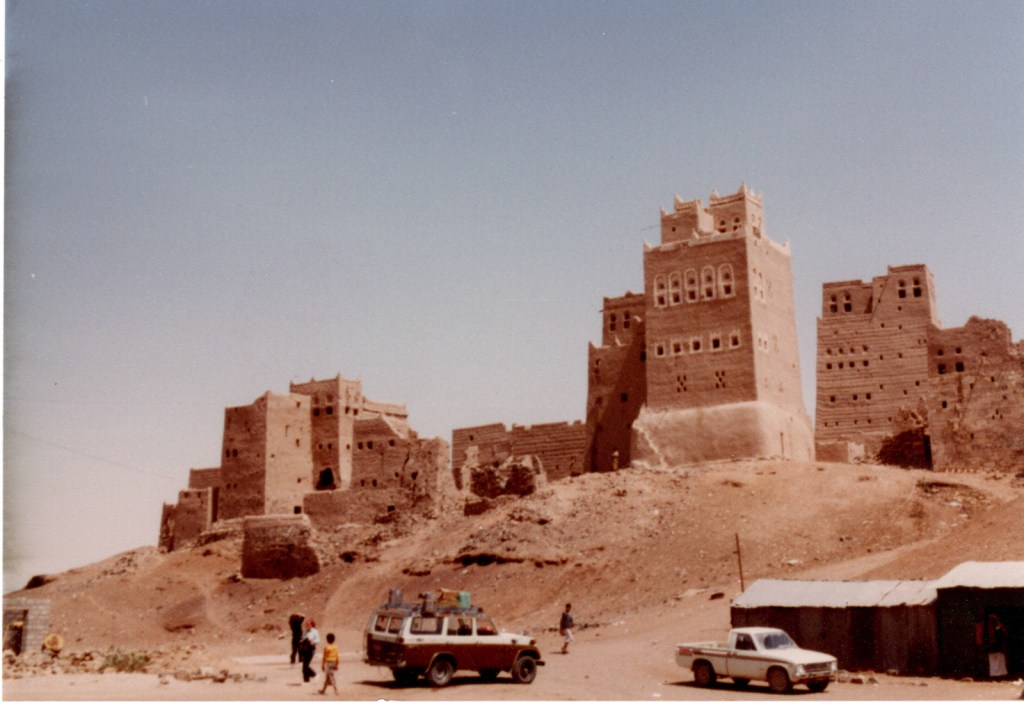
They climbed about taking photographs and had a picnic on the side of the road under the tamarisk trees. From then onto the temple area which she found disappointing as sand had blown in from the desert and it was hard to see what was what. The Temple of the Moon God, constructed 2500 years ago, had been a wonder of the world.
Thulla
Another day’s outing with Selma was to a town called Thulla.
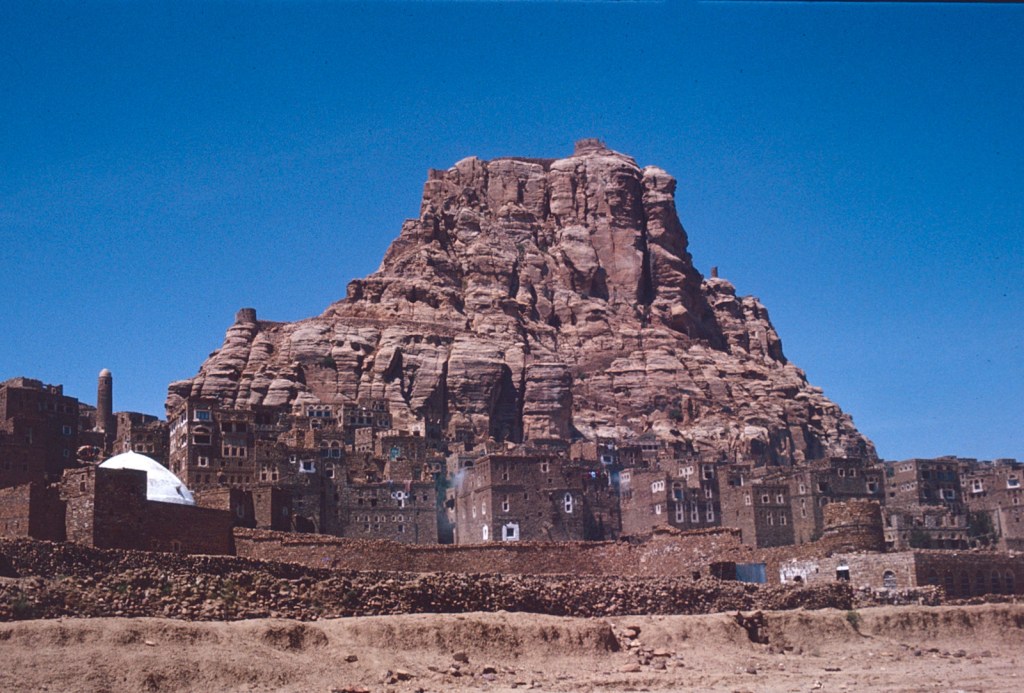
Crouching at the base of a rocky inselberg on which a fortress is perched from which the whole surrounding area can be scrutinised. [Thulla lies] mainly behind its walls which are intact and from above we could see four gates, one of them with a twisted entry for defence . The houses have an architectural style of their own, tall and stone- built… seems tidier than other towns.
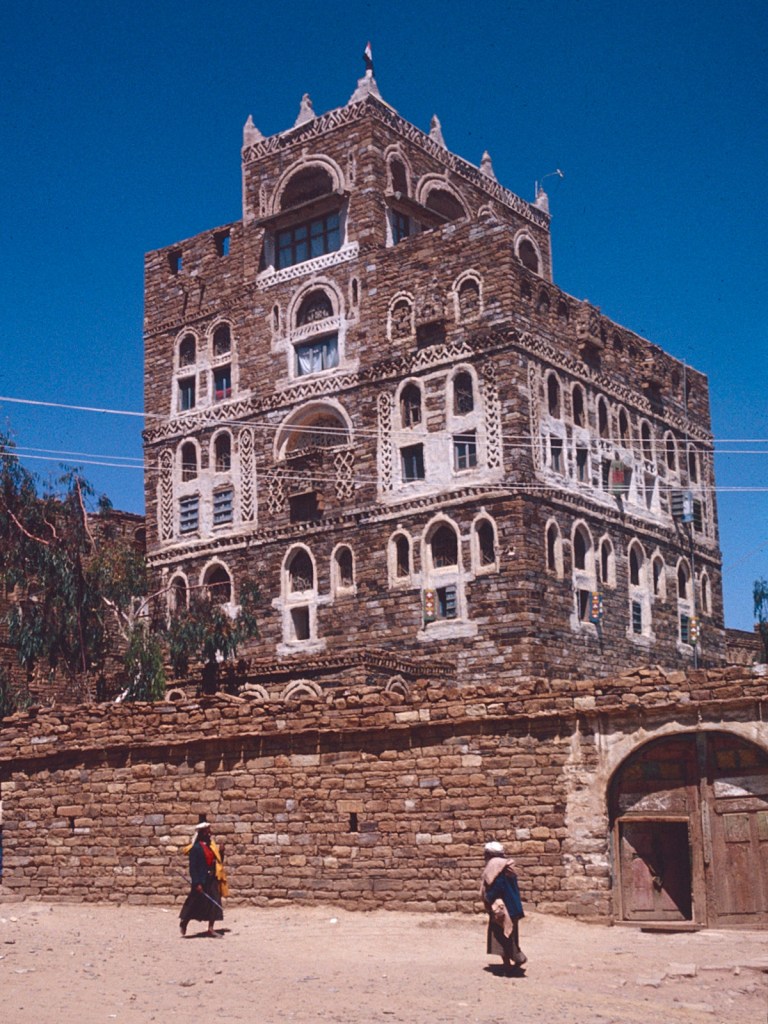
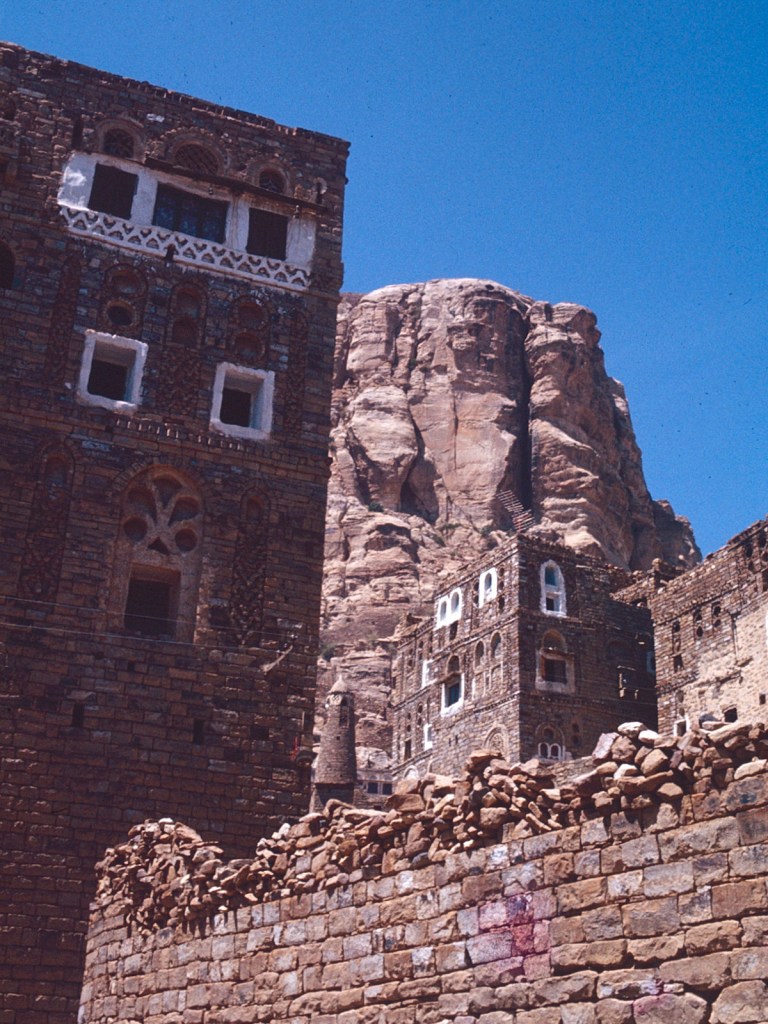
The streets are narrow, and twisting as anywhere …as we climbed we could see two big mosques each with domes and vast water tanks which appeared empty. Very little trouble from children going up as it was lunch-time but my hand was constantly seized by 4-5 on the way down and they wouldn’t let it go, albeit very good naturedly.
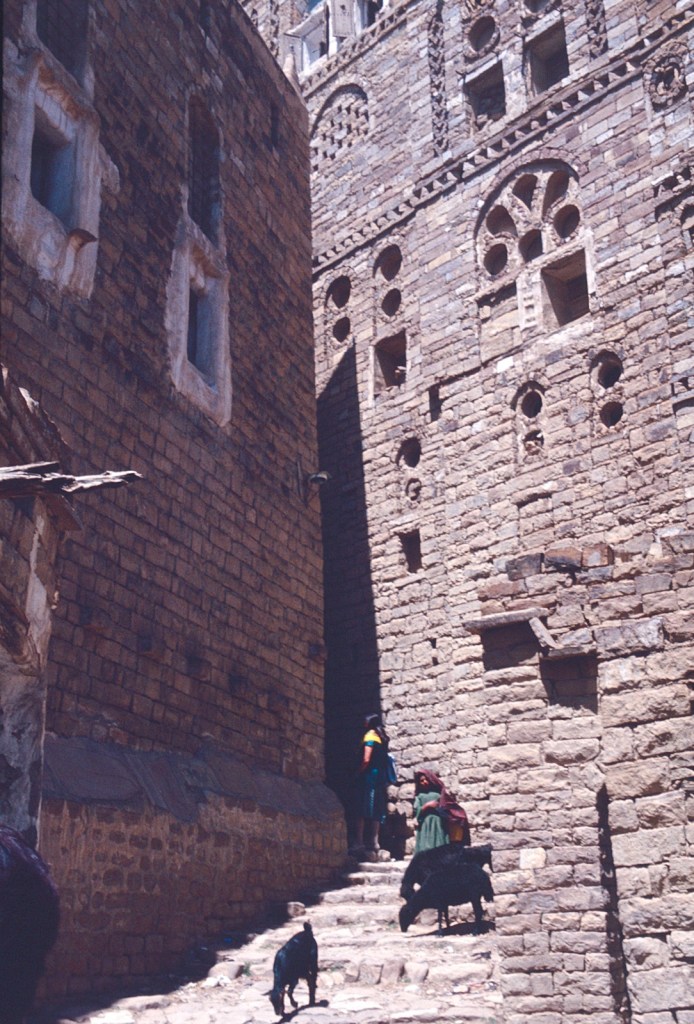
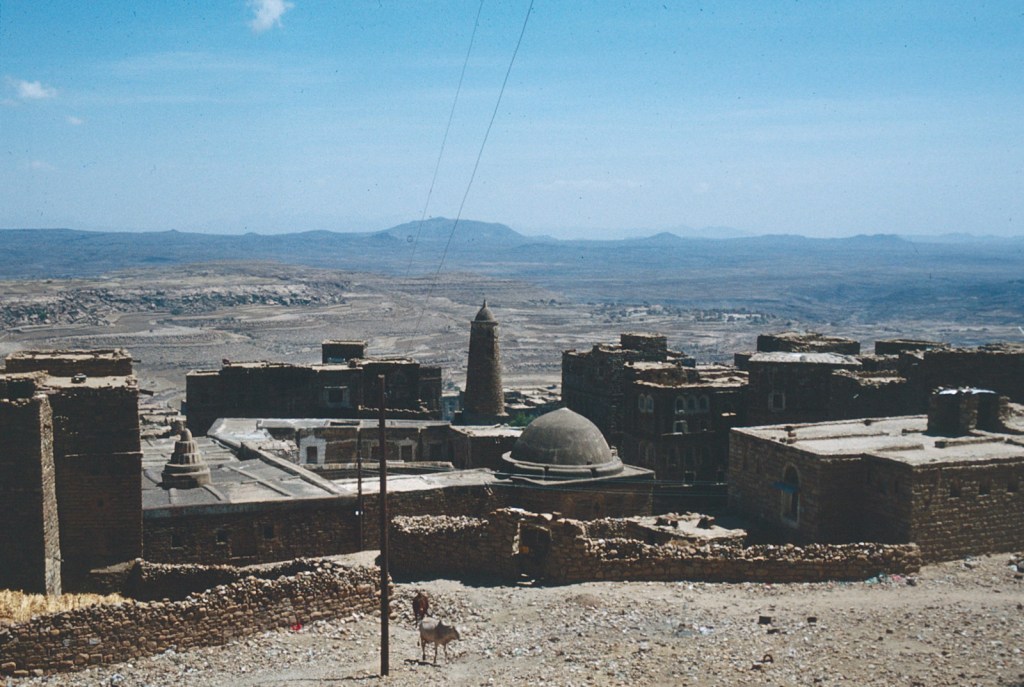
We started the climb up to the castle at the top of the steep rocky mountain, steps cleverly laid, wandered this way and that, the viewpoints breathtaking and we had to pass through two closed doors.
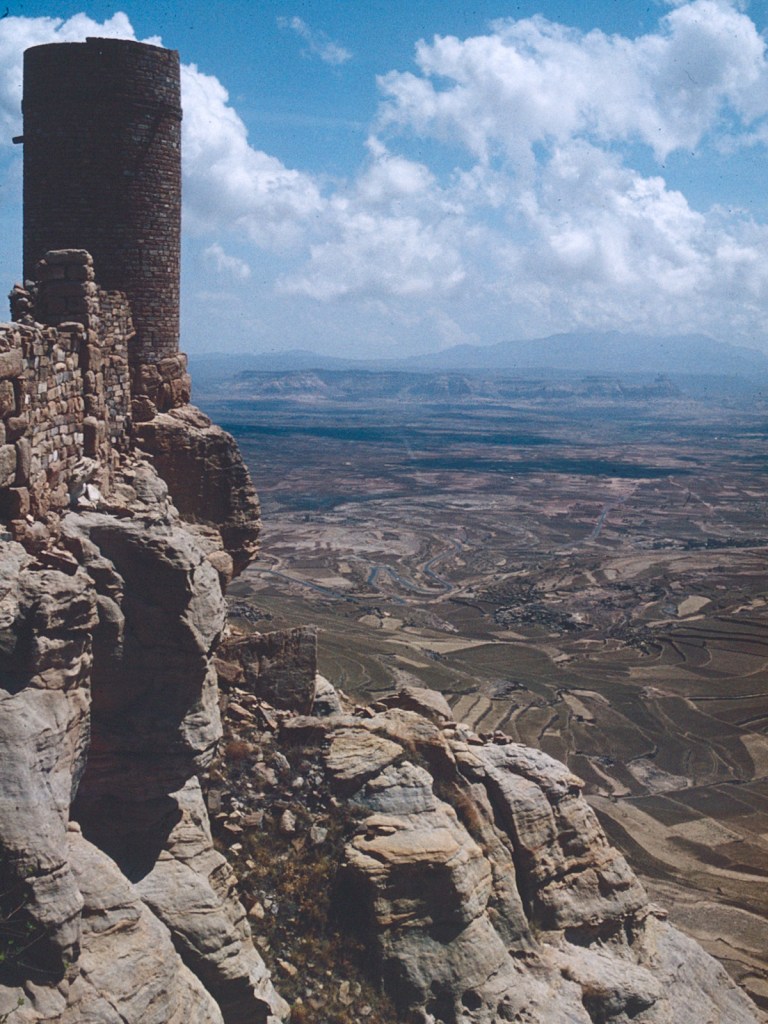
One seemed to be a kind of guard house, occupied by several me, the other just a tunnel through the rock. Eventually with many stops and puffing and blowing we reached a second round tower on the edge of a rock, where two men, middle-aged, and old men with beards were installed. Enclosed by a wall from the mountain side they had made little gardens and were growing shallots, herbs and almond trees
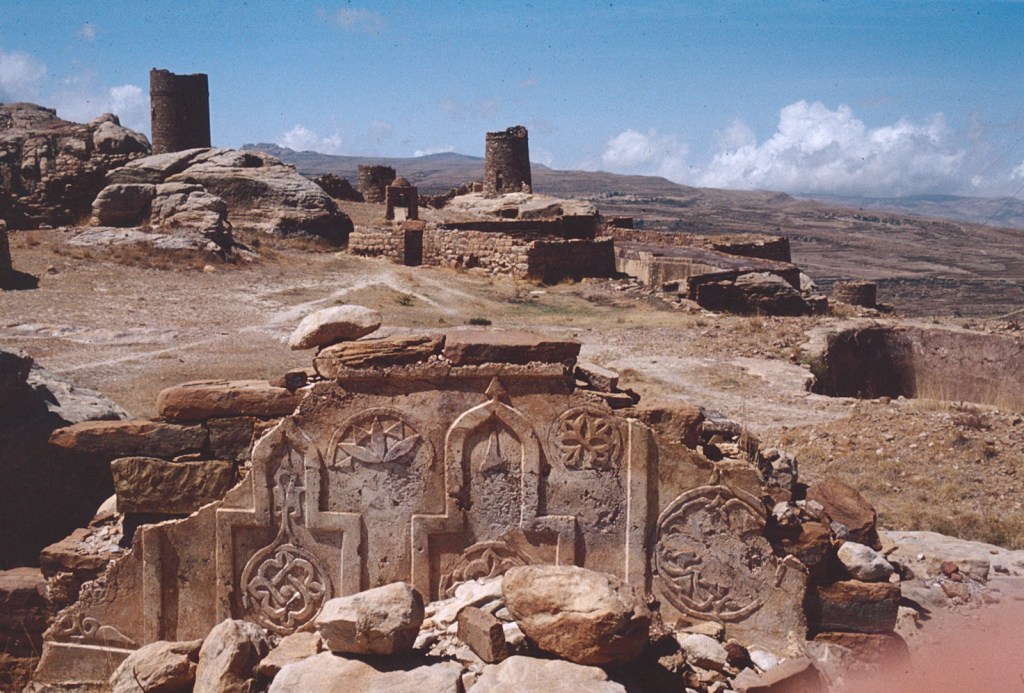
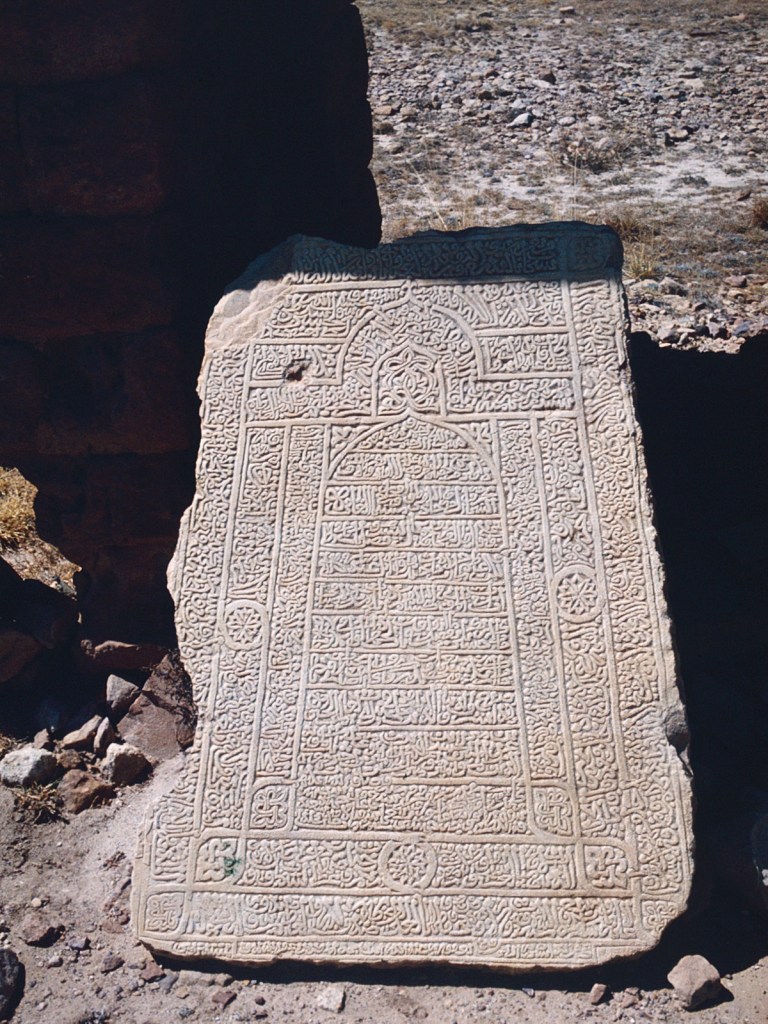
The whole of the defended area was surrounded by sturdy stone wall with look-out towers at intervals. We looked for shards and I even found a small coin, hexagonal, with a shadow of an inscription just visible. There were several small houses, each neat and well-cared for, two of them being cut into the rock, virtually caves. Little gardens lovingly attended were growing herbs, coriander and what looks like tarragon, basil and shallots. Almond trees were still darkly flowering and pinky mauve.
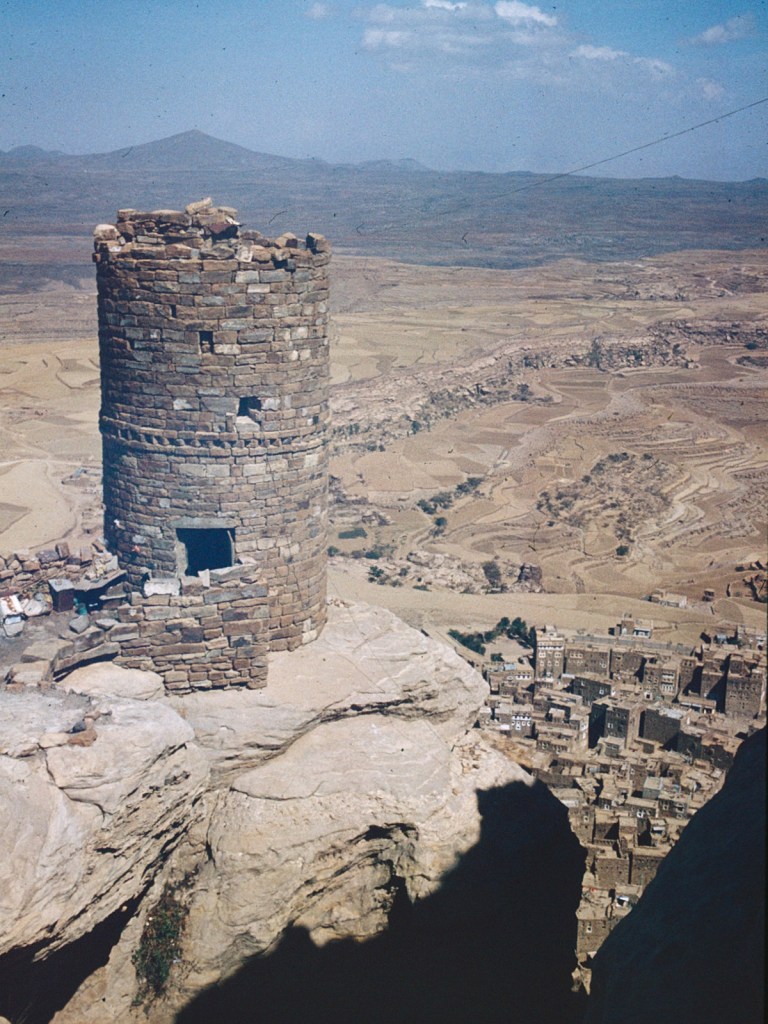
We had lunch on a big flat rock by the side of the road overlooking an unbelievable landscape of scrupulous terraces all round, awaiting the rains. Here and there you could see a flat shiny winnowing floor, each with its little hut and now and again, where the terrain is too rough to cultivate, groups or slabs of rock. A young shepherdess with black shaggy sheep and one improbably dappled goat watched our meal, shooing the animals off the road with stones when they strayed.
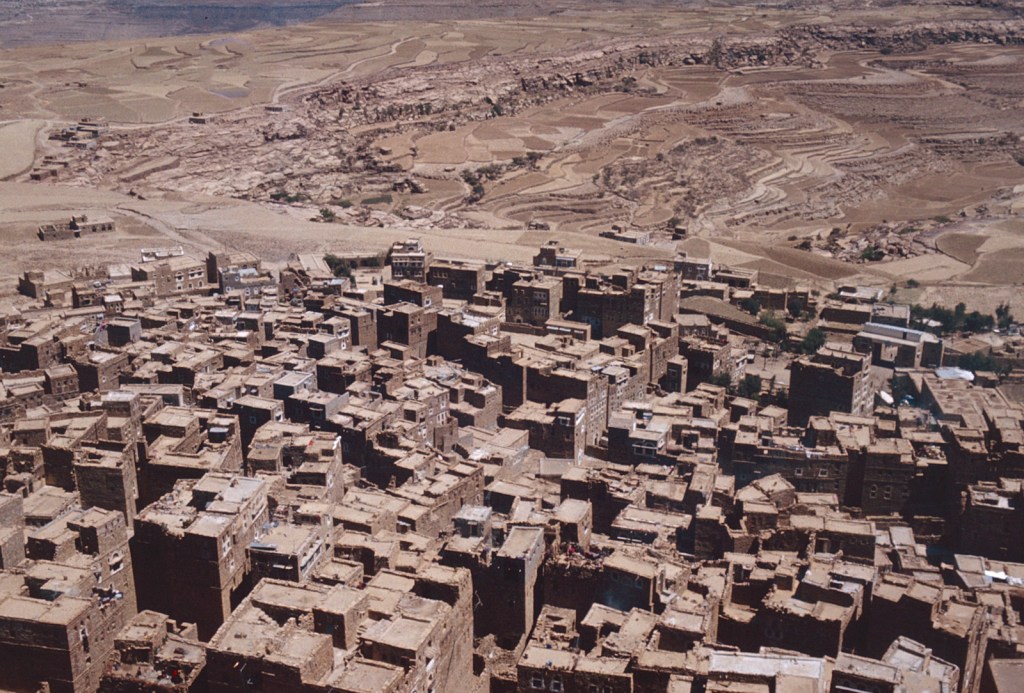
Driving back they took a random road through a pass to get a further view and an ‘astonishing sight of totally green terraces was revealed, the patchy sun now partially obscured by soft grey clouds lighting up first this place then that, and over to the left where the road twisted and leapt down over stones and bumps, the cultivation extended lush and green in patches with blue-grey mountains on either side until all was as one in the grey light: villages merged into the hill, lit up and then obscured.’
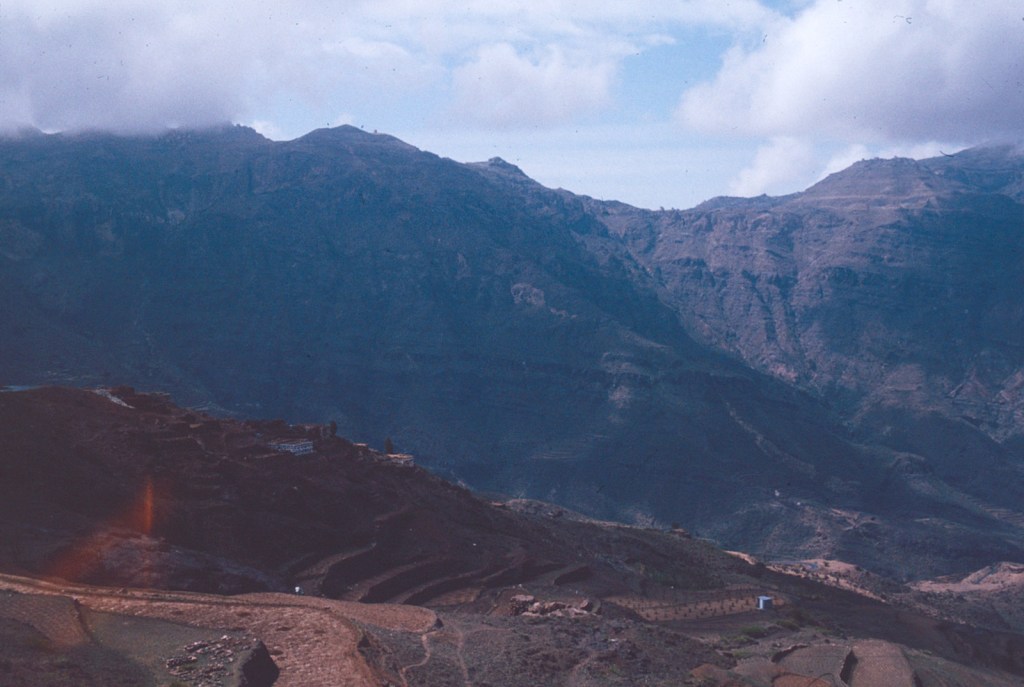
We turned back, the low sun cast warm shadows on the mountain-side villages in the distance all round, and habitations which were invisible at noon leapt out in geometric glow.
Manakha
Today to Manakha. I went round first thing to the Clarks to borrow a walking stick as it’s said the dogs are fierce.
There was an amusing incident en route where the taxi disgorged all its passengers while they went inside for qat, a rest, or whatever, and Sheila was motioned to sit on a wayside stone which she did surveying the scene: ‘many lorries, tankers, taxis and cars up and down, lots of children thronged round inquisitively. Eventually a man came and gave me a pear. This was followed by an apple from someone else and finally a man handed me 2YR. I couldn’t understand why; thinking he needed change. I opened my purse revealing very little whereupon he gave me a further 5YR. On seeing my surprise he motioned me to close my purse and pointed to heaven ‘Lillah’ [alhamdullilah – thanks be to God] he said – perhaps he thought I was an invalid with a stick or what I don’t know.’
Manakha is located past Hodeida. Having been subjected to a 3/4 hour sermon and a visit to a mosque to pray, ‘people suddenly became more jolly and qat was brought out, offered to me and the serious business of chewing, which one felt overlaid even the driving, began. The tape was put on but stopped after a couple of minutes and whole branches of denuded qat were tipped out of the car. My neighbour began to call me by my name and point out various features on the road which he felt merited a photograph and so we arrived at Lower Manakha’, where she transferred into a taxi in order to reach higher Manakha, called Airport, since an Egyptian helicopter landed there during the war.
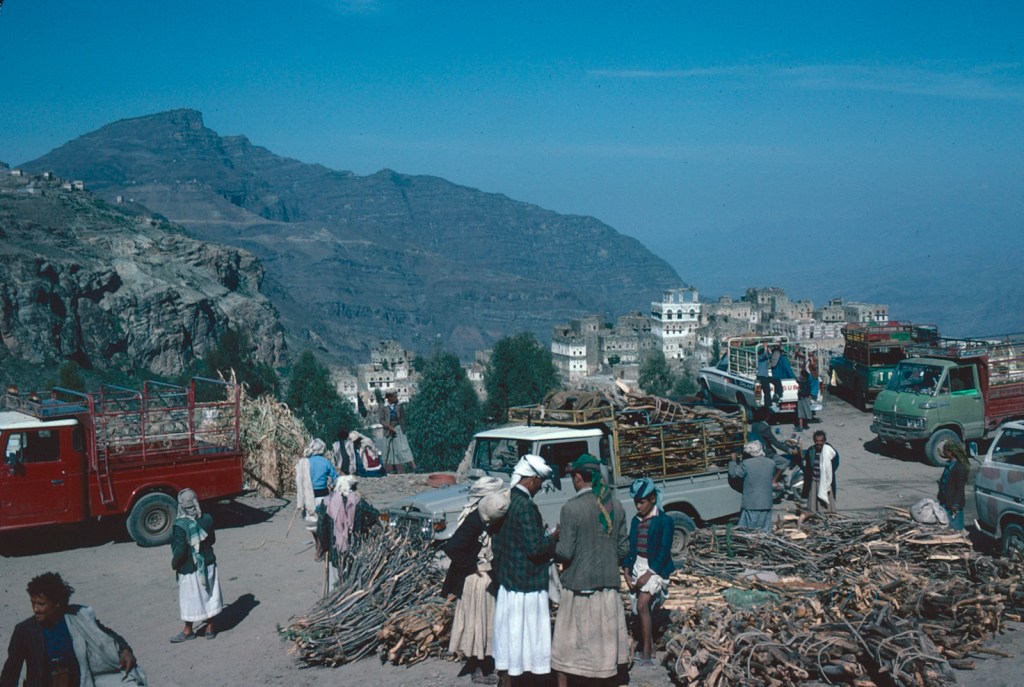
‘Manakha suddenly appeared around the corner of football pitch on the edge of the escarpment and houses on the hill rising up behind. The funduq was pointed out to me and I climbed up some exceptionally steep stairs to enter through a door into the kitchen courtyard.’ She was met by ‘a very unimpressive young man’ who finally showed her up to a very small room with four mattresses which was already occupied – ‘they said it was by a woman but there appears to be only the equipment for one man – shaving cream and big boots. Loos look modern but not clean.’ The story of her life.
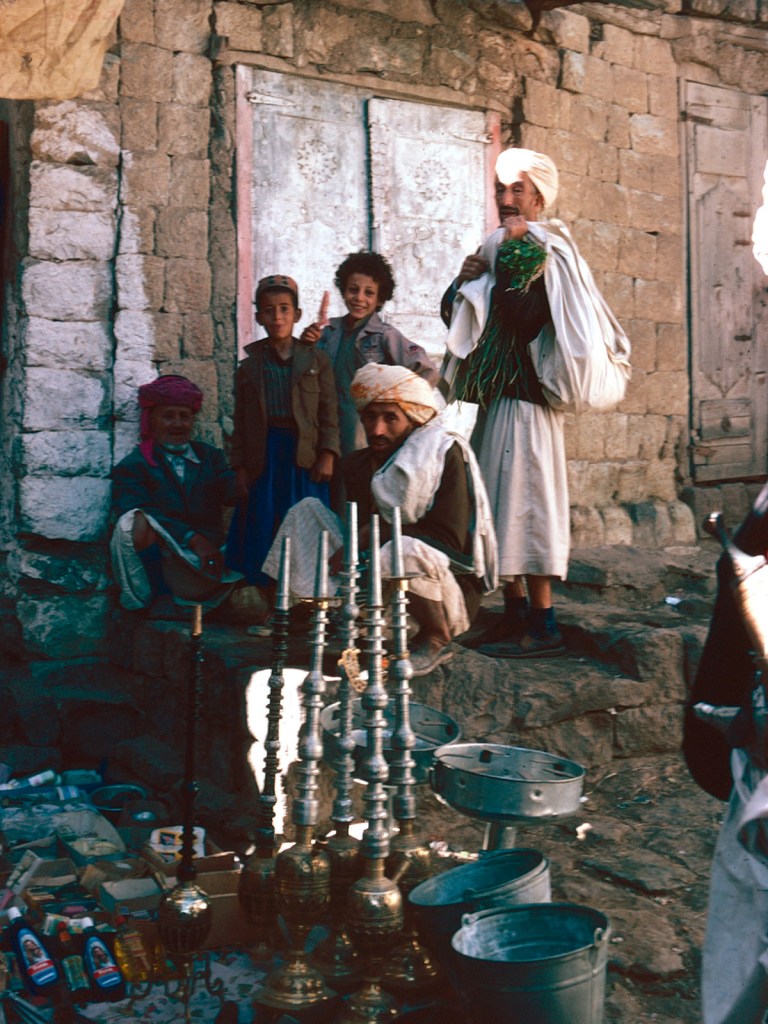
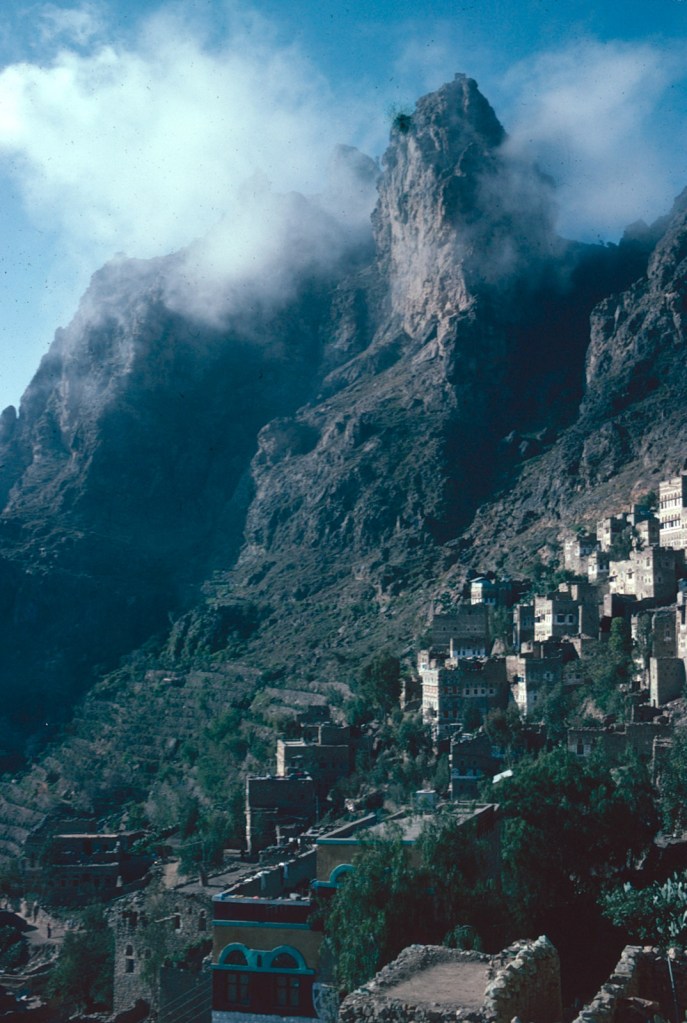
Once settled I took a walk through the town but was not very impressed. Many dogs and certainly it’s good to have that stick, and lots of children, many not pleasant, asking for bonbons, laughing at me and being generally unruly – some even flung stones at me. It is indeed a town built out of the rock being on a ridge between two mountains, the centre of the city being high with houses on top and all around, and a road sneaking round the perimeter with fine views down to a valley far below and on the west up to rocky precipices and crags upon which are perched matchbox-like houses rising in tiers. It’s all very dramatic. I noticed for the first time coffee growing and by the wayside a little white rose flowering in clusters.
Back at the funduq the mystery of the shaving cream in the room was solved when three Toyota land cruisers drew up containing French tourists. She went to her room to rest but was disturbed by ‘a middle-aged, unsuitably-dressed. French woman negotiating for two couples to occupy my room. The original occupant is a man, a jolly curly-headed Canadian who appeared from a five-hour walk in the mountains a bunch of flowers in his hand and good natured. He agreed to move out to a smaller room for the night. I made it clear that I was already in occupation so the five of us will share the small place which is not more than 15′ x 12′.’
Despite being obviously put out, Sheila chatted to the two French women from Grenoble who were friendly and pleasant. They had had a car and driver and were driving around for two weeks, which she thought was quite enterprising.
Somehow the five of them got through the night although Mum was very uncomfortable and at 4/5 am she got up and managed to wash and get dressed for the day while the others appeared to be asleep.
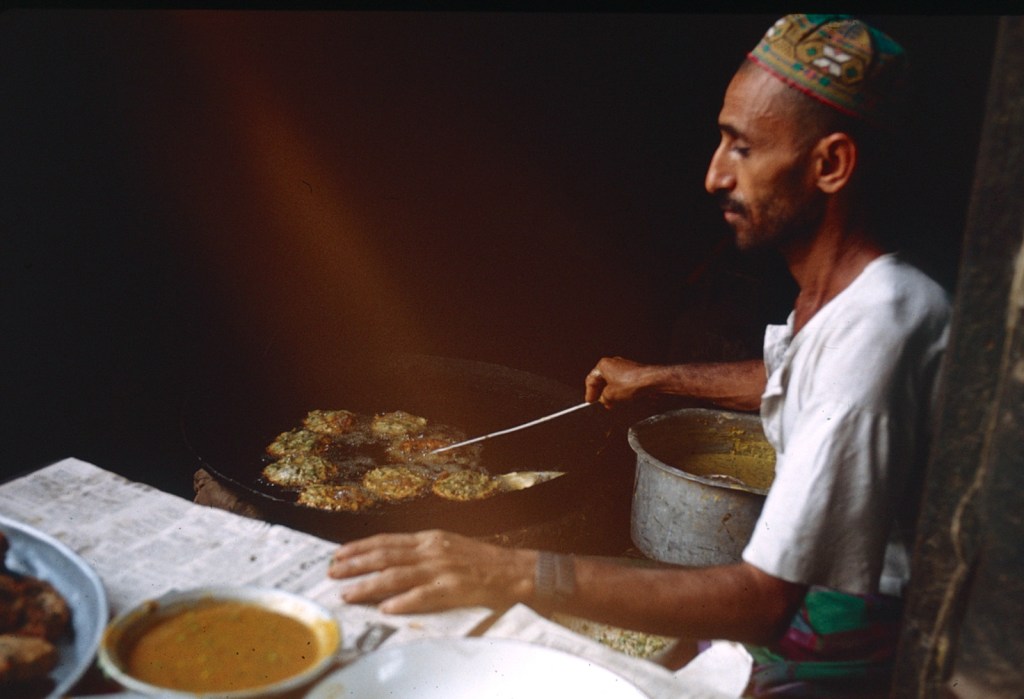
She decided to try and break away from the French and visit Hutayb, where the Canadian said he’d seen a chest in a house, and where there was an Ismaili shrine. To do this, she had to go through the suq, which was now ‘full of people, all shops and booths open in every small corner and open space, and on each side of a wide stairway leading up into the central activity, people in from the villages were displaying and selling goods. I followed up the stairs behind a man bearing the severed head of a huge bull and at the top there were several shops selling freshly slaughtered meat, lettuce, tomatoes, shallots and the tops of shallots – all were changing hands rapidly and the food shops were doing a brisk trade in the sale of freshly fried batter-like bread all bubbly and crisp from the boiling oil.’
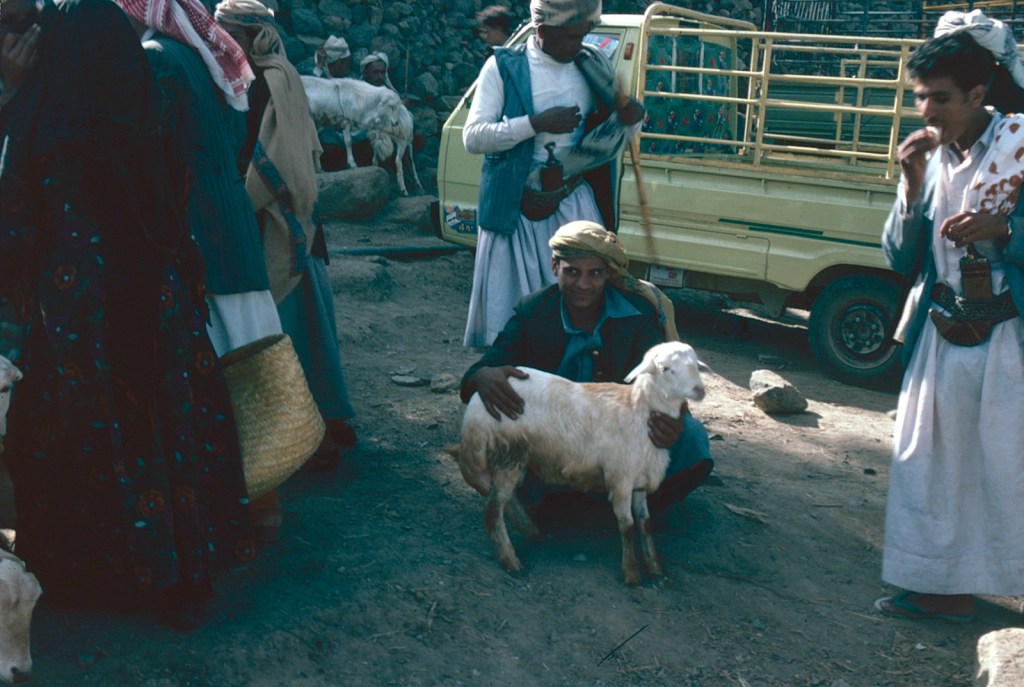
She passed the government offices, ‘where petitioners sat and chatted in small groups, some with papers in their hands. Watermelon slices were deliciously cool and sweet and donkeys waited to eat the discarded skins.’ Other livestock was confined to the Airport area which was ‘thronged with pickups, small lorries, jostling and manoeuvring, parking and the shouts and general pandemonium overlaid all else.
Beyond the Airport west to Hodeida, a vast view over terraced slopes, the Chinese Road snaking down among the magnificent mountains rearing up on all sides, crested with improbable villages clinging to the ridges and summits the whole vista melting into a blue grey haze the further it reached.
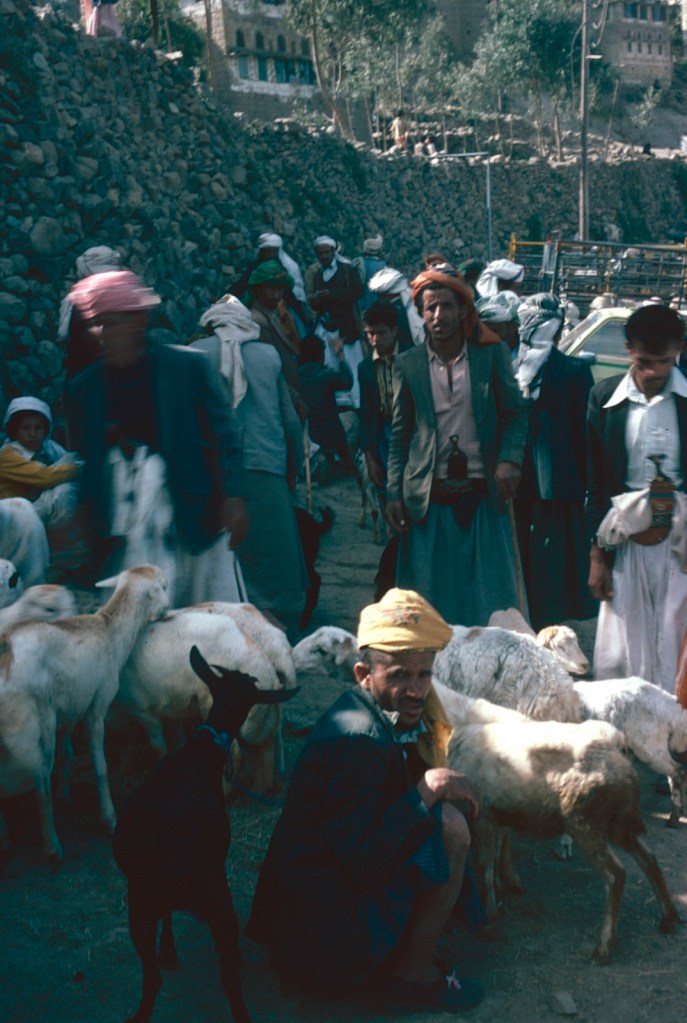
There were a surprising number of unsuitably clad tourists ‘who appeared to excite little comment but the children and young men were cheeky… but as for the local adults none could have been more charming. Several middle-aged men stopped to ask me where I was from. They beamed when they guessed Britannia after a fifth or sixth try. An unveiled woman greeted me every time I passed her, her hand stretched out to my rings, indicating she’d like my small turquoise one for her little finger and smiling good-naturedly when I shook my head.’
Time was passing and she began to think again of Hutayb so she wandered down to the Airport but found that taxis there went to Sana’a and she had to go to the other side of town. However she couldn’t find a taxi at a reasonable enough price and decided to abandon the idea and have lunch before returning to Sana’a. Despite the setbacks it was an exciting way to end her visit to the Yemen, which had lasted over a month.
 Travels with my mother